How the intelligent dealership regains its tribal knowledge
Editor’s note: This is the final instalment of a four-part series by Dennis Gray on how independent pool and spa dealers can use artificial intelligence (AI) to keep expertise in the business.
This is a number that should keep every dealer owner awake at night.
Skilled workers are leaving North American trades faster than new ones are arriving. According to recruitment data from Handshake, applications per technical job posting among students using the platform fell by 49 per cent between 2020 and 2022.1 BuildForce Canada projects that approximately 269,000 Canadian construction workers will retire by 2034, taking with them decades of practical experience and industry knowledge.2 In the backyard leisure industry, this is not an abstract workforce trend. It is Dave.
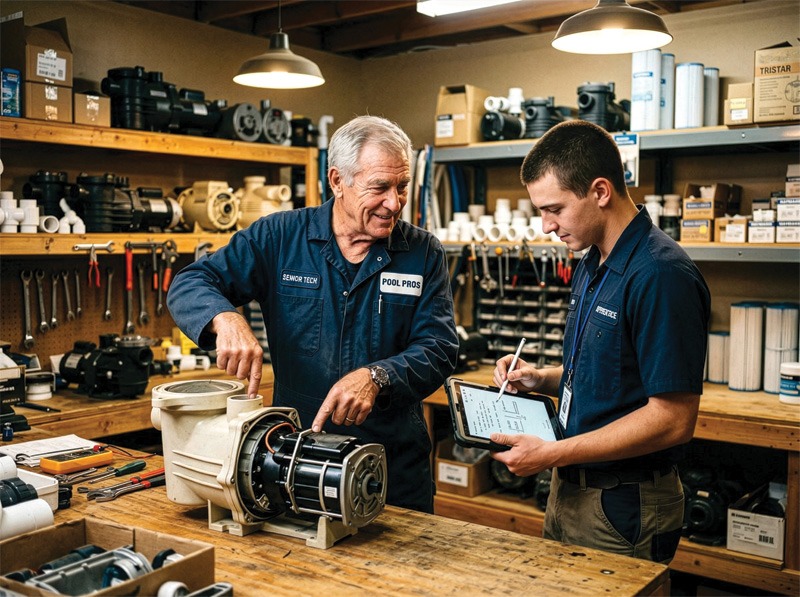
Dave is a 28-year veteran. The one everyone calls when they are stuck. He can diagnose a heater problem by listening to it cycle. He knows that the calcium hardness in the west end of town runs 30 per cent higher than the east side because of a water main junction nobody documented. He can look at a water sample and know—before the test results come back—whether it is a phosphate problem or an early-stage algae bloom, because he has seen 10,000 samples and his pattern recognition runs on nearly 30 years of data.
None of that knowledge is written down. It lives in Dave’s head, in handwritten notes stuffed in a toolbox, and in instincts he cannot fully articulate. When Dave retires six months from now, that knowledge will not transfer to the next generation—it will vanish. And with it goes the diagnostic speed, the first-call resolution rate, and the customer confidence that Dave’s expertise made possible.
This is not a staffing problem. Staffing problems have staffing solutions. This is a knowledge extinction event, and it requires a fundamentally different response.
Three kinds of tribal knowledge
Not all knowledge loss is the same. Understanding the three categories is the first step toward preventing it.
Leakable knowledge is expertise that walks out the door when an expert leaves. It is undigitized, undocumented, and irreplaceable through conventional training. Examples include Dave’s diagnostic intuition, the retail manager who knows every hot tub owner’s personality and buying patterns, or the installation specialist who can look at a mechanical room and know instantly whether the equipment layout will create service problems in two years. This knowledge was never captured by anyone else because nobody thought to capture it; it remained accessible until the person left.
Static knowledge is expertise that technically exists in documented form—but nobody uses it. This includes the three-ring binder of equipment manuals that has not been opened since 2019, the training videos from a product launch four years ago, and the installation guide that was accurate when it was written but does not reflect the three product updates since then. Static knowledge is not lost. It is trapped—locked in formats that are too slow, outdated, or inaccessible to be useful at the moment of truth.
Scarce knowledge is expertise that only one or two people in the organization possess. This could be the person who knows how to configure the salt system for the commercial installation, the technician who has diagnosed every heat pump model on the market, or the retail associate who has closed more hot tub sales than anyone in the company’s history. Scarce knowledge is not documented; it is not widely distributed, and when the one person who has it is unavailable—sick, on vacation, retired—the entire operation degrades.
Every dealership has all three. And every dealership is losing all three—to retirement, turnover, and the simple passage of time. The question is not whether knowledge is being lost. It is about whether it is being captured faster than people leave.
Tribal knowledge taxonomy |
Leakable knowledgeExpertise that walks out the door when an expert leaves—undigitized, undocumented, and irreplaceable through conventional training. This means Dave’s diagnostic intuition, retail managers’ relationship maps, and installation specialists’ spatial judgment. |
Static knowledgeExpertise that technically exists in documented form—but nobody uses it. Binder manuals, outdated training videos, and installation guides that no longer reflect current products. Not lost but trapped in formats too slow or outdated to be useful at the moment of truth. |
Scarce knowledgeExpertise that only one or two people in the organization possess. The salt system specialist, the heat pump diagnostician, or the top-performing sales associate. It is neither documented nor widely distributed. When that person is unavailable, the entire operation degrades. |
Meet Sage: the retail JARVIS
Throughout this series, the articles have described what an AI-augmented dealership can do using general-purpose tools configured by skilled humans. It is time to see what happens when AI is purpose-built for backyard leisure from the ground up.
Sage is an AI advisor designed to live on every team member’s phone and every customer-facing screen in the dealership. It is not a chatbot, and it is not a search engine. It is the embodiment of the Augmented Human Intelligence (AHI) principle—a system that knows because of people, not instead of people.
When Priya—the retail associate from the third article—faces a customer with a complex water chemistry question, Sage does not give her a generic answer pulled from the internet. Sage draws on more than 50 years of accumulated water treatment science, product-specific formulations, regional water profiles, and diagnostic protocols developed by the people who created the products. It knows the product line the way Dave knows it—because Dave’s knowledge, and the knowledge of every expert who built these products, is encoded in the system.
Sage operates in multiple modes. In dealer staff mode, it provides comprehensive diagnostic support, product recommendations, and selling guidance calibrated for the trained professional. In consumer mode—available to homeowners through the dealership’s digital channels—it provides accessible, brand-specific guidance that drives product usage and subscription renewal.
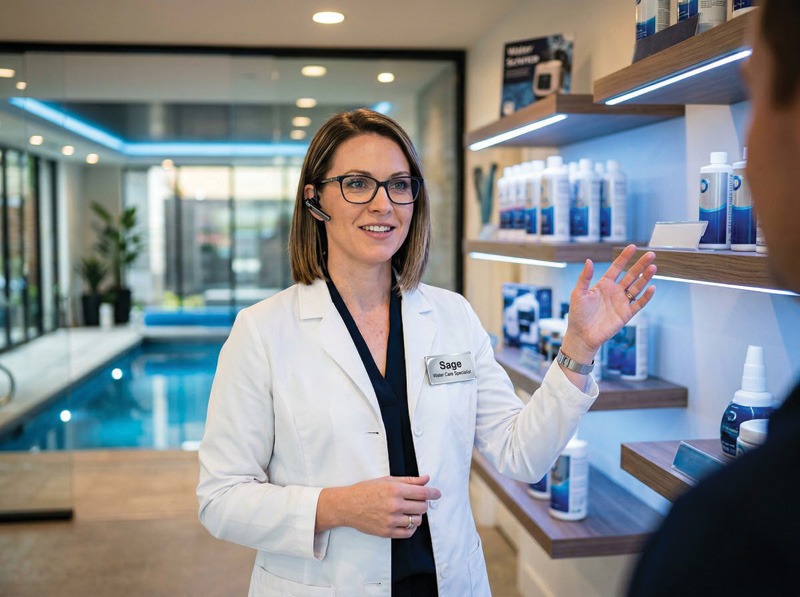
This is not a future product. Sage is live and deployed across hundreds of Canadian dealerships. It has been demonstrated at dealer conferences across the country and is operating on iOS, Android, and the web. It is learning from every interaction, growing more capable with every question, becoming more valuable with every deployment.
Remember Sarah from the first article—the associate who diagnosed the water chemistry cascade failure in four minutes? That was not hypothetical; it was Sage in action.
Meet Rocky: the field JARVIS
If Sage is the suit for the retail floor, Rocky is the same thing for the mechanical room.
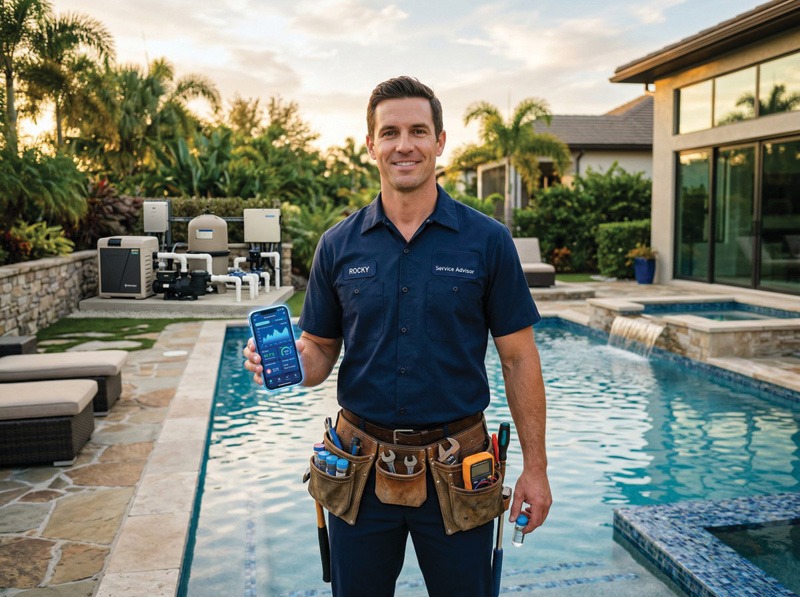
Rocky is the AI-powered field service companion designed for technicians. It is voice-activated and hands-free. When James encounters the erratic pump cycling described in the third article, Rocky is the voice in his ear. It walks him through diagnostic sequences, identifying probable causes, confirming his instincts, and providing equipment-specific guidance drawn from a comprehensive knowledge base of installation procedures, troubleshooting decisions, parts identification, and field-proven repair protocols.
The design principle behind Rocky is simple and absolute: hands on tools, eyes on work. A technician in a mechanical room cannot stop what they are doing, pull out a phone and look for an answer, and then resume the repair. Rocky replaces that broken workflow with a conversational interface working the way field technicians do—by talking through the problem.
“Rocky, I’ve got a variable-speed pump cycling on and off every four minutes. No error code on the display. The capacitor was replaced last week by another company. What should I check next?” James asks. Rocky responds with a diagnostic sequence tailored to the equipment, symptom pattern, and repair history. The technician never takes their hands off their work. Their eyes never leave the equipment. Dave’s knowledge, distilled and multiplied, is right there, at the moment of truth.
The Iron Man parallel is completed here. Rocky is the field service suit. The camera on the technician’s phone or in their smart glasses captures what the technician sees. Rocky’s knowledge base interprets what it sees; the technician drives the interaction, the repair gets done, and the customer is served.
The knowledge that made it possible did not come from a manual nobody reads or a phone call to an expert who is no longer there. It came from an intelligent system that carries 53 years of expertise in every technician’s pocket.
As writer, inventor, and explorer Arthur C. Clarke stated, “Any sufficiently advanced technology is indistinguishable from magic.” To the homeowner watching a first-year technician diagnose their equipment with the confident fluency of a decades-long veteran, it does look like magic. But behind that confidence is a system, a methodology, and a principle: to build tools that make humans more capable, never less necessary.
The accretive loop: knowledge that compounds
Here is where Sage and Rocky become something more than applications. Here is where they become a moat.
Every interaction makes the system smarter. Every water chemistry diagnosis adds to the pattern library. Every equipment troubleshooting sequence refines the diagnostic decision tree. Every customer interaction that ends successfully reinforces the recommendation engine. Every interaction that fails teaches the system what to do differently.
This is not static software that ships a version and waits for the next update. This is a learning system that compounds. The more the team uses it, the better it gets, and the better it gets, the more the team uses it. This widens the gap between a dealership’s capabilities and those of its competitors.
Think about that in competitive terms. A dealership that deployed Sage and Rocky six months ago has six months of accumulated learning baked into its system. A dealership that deploys today starts with a full knowledge base but lacks local learning. A dealership that waits another year falls further behind—not linearly, but exponentially, because the learning compounds.
This is the early-adopter advantage described in the first article, made concrete. The advantage is not just that a dealership started using AI first; it is that their AI has been learning from their specific market, customers, and challenges for longer. That learning cannot be purchased. It can only be earned through deployment.
The underlying architecture of both Sage and Rocky is designed to work across any field service industry where human expertise matters—a patent-pending platform that captures, compounds, and delivers domain-specific knowledge at the point of need. For backyard leisure dealers, it carries the accumulated wisdom of five decades of water treatment science and product innovation. The architecture itself, however, is industry-agnostic. The fuel changes, but the engine is the same.
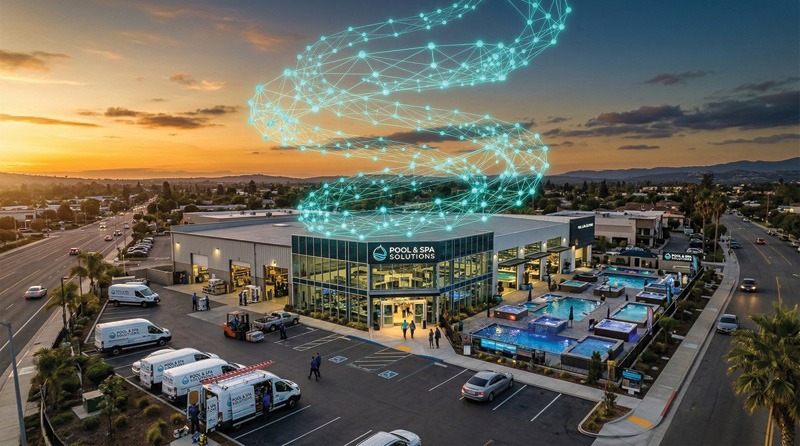
Dave’s knowledge does not retire
Going back to Dave. He is six months from retirement with 28 years of diagnostic intuition. As the person everyone calls, he has the dealership’s institutional memory, walking around in work boots and a company polo.
In the old model, Dave’s last day is a knowledge funeral. Colleagues say nice things at the retirement lunch and wish him well. Then the calls that used to go to Dave start going to voicemail, junior techs who do not have the answers, or to competitors who do.
In the AHI model, Dave’s last six months have been a period of knowledge harvesting. As he works through his final season of service calls, the system observes. It captures his diagnostic patterns and records the questions he asks and the order in which he asks them. The system also details the judgment calls—the moments when Dave overrides the obvious answer because something about the situation does not feel right—and he has learned to trust that instinct over three decades. It documents the shortcuts, the field-tested workarounds, and the “try this first” heuristics that no training manual contains because nobody ever thought to write them down.
Not every piece of Dave’s expertise can be captured. The human element—the reassuring tone with an anxious customer, the rapport built over years of service, the judgment that comes from having seen everything twice—that stays with Dave.
But the diagnostic knowledge, pattern recognition, and decision frameworks do not have to leave with Dave. They become part of the institutional intelligence that every current and future team member can access, at every moment of truth, forever.
Six months after Dave’s retirement, two new technicians at the dealership are performing at levels that used to take five years to reach. They are not as good as Dave; nobody is. But they are 80 per cent of him on their toughest day and getting better every week, because the knowledge that feeds their AI assistant is still growing, compounding, and learning.
Dave’s knowledge did not retire with him—it actually multiplied.
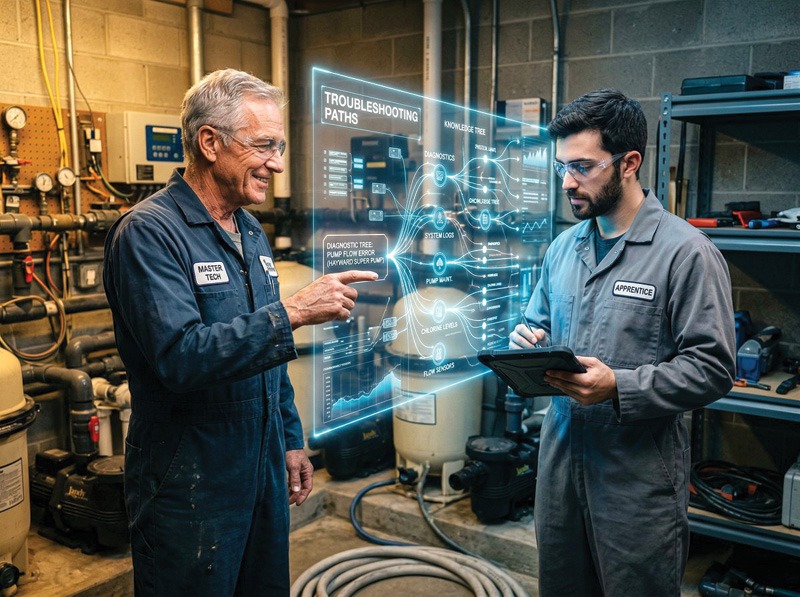
The invitation
Four articles. One argument. The backyard leisure industry is at an inflection point. The expertise that built this industry—the diagnostic intuition, the product knowledge, and customer relationships that make independent dealers irreplaceable—is walking out the door faster than it can be replaced through traditional means. The poachers and pillagers, such as online retailers, mass merchants, and mobile service companies, do not need dealers’ expertise. They compete on convenience, price, and scale, and they are winning customers who should be with traditional dealerships.
But they have a structural weakness. They cannot replicate what dealers know, cannot build the relationships a dealer’s team builds, and cannot deliver the judgment, empathy, and accountability that a skilled human provides face-to-face. They can sell a box of chemicals, but they cannot look a homeowner in the eye and say, “If this doesn’t work, I’ll fix it,” and mean it.
AHI does not replace that advantage; it amplifies it. It captures it before it retires and multiplies it across every team member. It makes it available at every moment of truth—on the retail floor, in the service van, and in the customer’s backyard at 6:30 p.m. on a Tuesday.
Sage and Rocky are live, deployed, and learning across hundreds of Canadian dealerships. The four skills these articles discussed—prompt engineering, concept engineering, context window management, and the discipline to choose real tools over free toys—are learnable by any team willing to invest the effort.
The three futures named in the first article have not changed. AI will replace teams, augment teams, or dealers will pretend nothing is happening and watch the parking lot empty one customer at a time.
The “intelligent dealership” is not a prediction, but an invitation. The competitive window is open. The knowledge is harvestable. The moat is buildable.
The only question is whether dealers will be among the first to suit up—or the last to realize they needed to.
Notes
1 Handshake recruitment data, as reported by Scripps News, “Fewer young adults applying for trade positions despite more openings,” WRTV, Jan. 24, 2023, wrtv.com/news/fewer-young-adults-applying-for-trade-positions-despite-more-openings
2 BuildForce Canada, “Construction and Maintenance Looking Forward 2025–2034” (2025).
Author
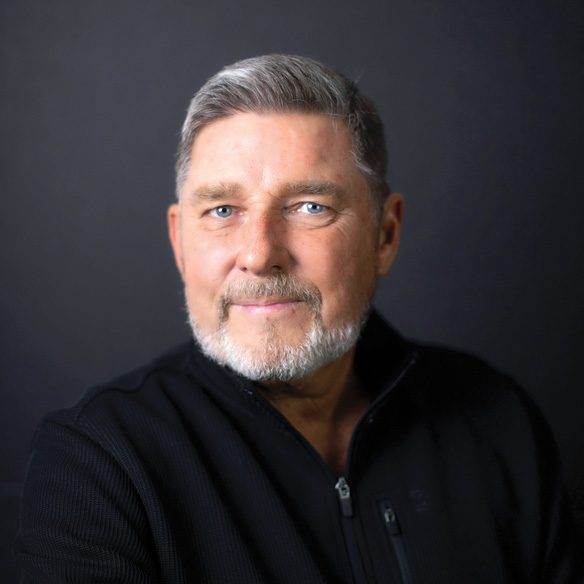
Dennis Gray is president of Backyard Brands Inc. and the architect of the Augmented Human Intelligence (AHI) platform deployed across more than 260 independent Canadian pool and spa dealerships. With 53 years of industry experience, he leads Backyard Brands’ mission to ensure that independent dealers build the expertise moat that makes them irreplaceable.
Sign up for our newsletter
Get all the latest news and features from Pool & Spa Marketing. Submit your email below to get our twice-monthly newsletter.
Products

Read the Latest Issue