
What homeowners are actually asking for in 2026
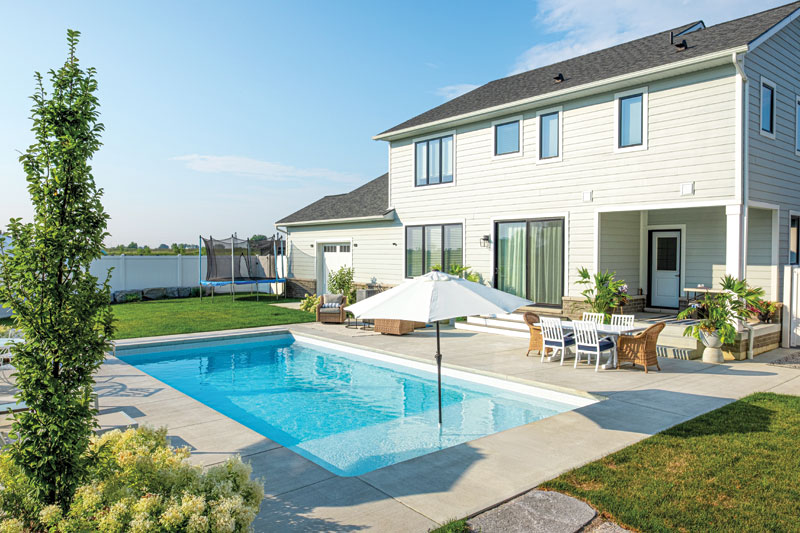
Backyard design in the pool and spa industry has long been tied to scale and visual impact. Large pools, deep ends, and dramatic water features were often seen as the defining elements of a successful build, with how a space looked taking priority over how it was used. In 2026, that approach no longer carries the same weight.
A shift toward lifestyle and functionality
A more grounded, lifestyle-driven approach to outdoor design is taking hold. To better understand how this trend is unfolding across the country, insights were gathered from three industry-leading pool builders from Western, Central, and Eastern Canada.
Homeowners are asking more practical questions from the very beginning. They want to understand how a space will function on a Tuesday evening, not just how it will look on a Saturday afternoon with guests. This shift toward real usability is reshaping backyard design across Canada and mirrors broader changes in residential living. People are starting to see their backyard the same way they see any other room in their home: as a space that needs to function, flow, and fit their day-to-day routines. They are now looking to pool and spa professionals not simply to execute a plan, but to bring vision, show what is possible, and help set the tone for the entire project from the outset.
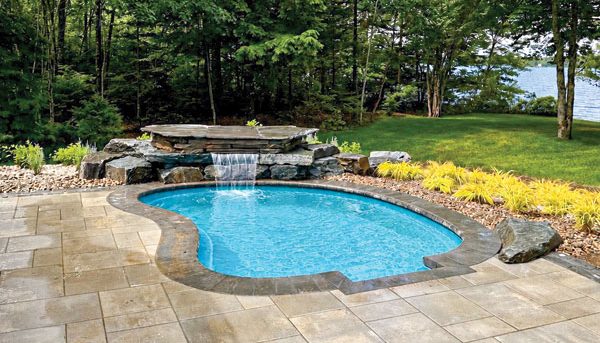
Research from organizations like the National Association of Home Builders (NAHB) continues to show that outdoor living spaces remain among the most desired home features. Still, the motivation behind that demand has changed. Homeowners are no longer investing in their backyards to boost property value or curb appeal. They are investing in spaces that extend their living environment and support daily life in a more meaningful way.
That reality is being reinforced on the ground. Jessica Russell, owner of Backyard Dreams Pool Design and Construction serving Halifax and surrounding areas in Nova Scotia, notes that the starting point for most projects has fundamentally changed. “Homeowners are reimagining their backyards as full outdoor living spaces, not just a place for a pool,” she says, explaining clients are increasingly focused on building environments supporting everything from quiet downtime to full-scale entertaining.
A clear reflection of this change is happening inside the pool itself. For decades, larger and deeper pools were widely perceived as the premium option, driven by a mix of tradition and assumption. Deep ends and diving boards were considered standard, even when they were rarely used. Today, that thinking is being challenged by a more realistic understanding of how people interact with their space.
“There’s also been a noticeable decline in requests for deep ends of 2.44 m (8 ft). Instead, clients are leaning toward more social, functional depths—typically in the 1.22 to 1.52 m (4 to 5 ft) range, like what you’d see in southern climates,” Russell adds. “This allows for standing, conversation, and relaxed enjoyment of the water, making the pool more usable for longer periods throughout the day.”
Designing backyards for everyday living
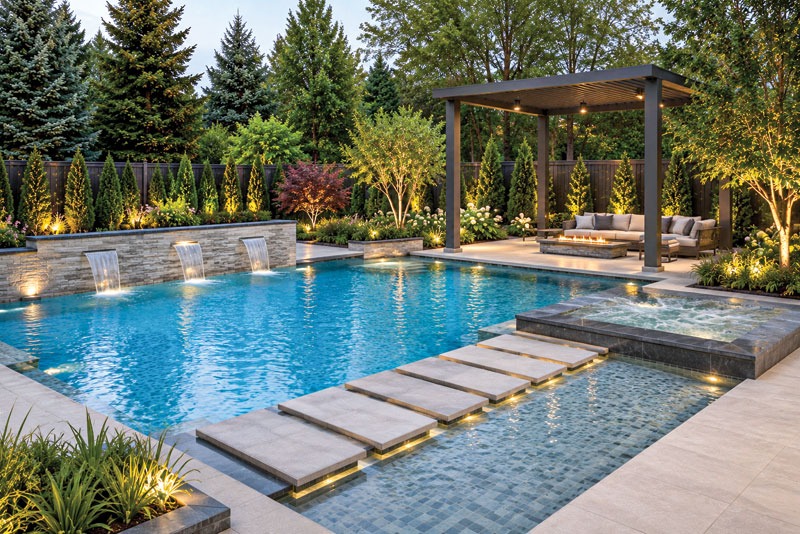
Across the industry, there is a noticeable shift toward shallower, more functional pool designs that prioritize usability over volume and account for the smaller lots being sold with new homes. Tanning ledges have become a staple in modern designs, not just as a visual upgrade, but because they naturally support how space is used. Whether it is a place for kids to play, a spot to lounge partially submerged, or an area to gather without fully committing to a swim, tanning ledges add flexibility, aligning with how these environments are being lived in.
Andrew Kondi, president of Rocky Mountain Pools and Spas in Calgary, Alta., has seen this consistently in Western Canada. He notes that clients are increasingly choosing layouts where “most or all of the pool is usable space,” with deep ends and diving boards becoming less relevant to how people spend their time in the water.
This same progression becomes even more apparent during the design process. Mike Priest, president of River Rock Pools serving the Windsor-Essex area in Ontario, says once clients are introduced to features such as tanning ledges and integrated seating, their priorities begin to shift.
“Homeowners are increasingly looking for fully custom pools designed around entertaining and lounging,” he says, highlighting the growing importance of features supporting interaction and comfort rather than sheer scale. “Pool size tends to reflect the client’s lifestyle: smaller, more intimate pools suit homeowners who are looking for a personal sanctuary, while larger families with kids and grandkids tend to prioritize bigger pools built for fun activities and weekend gatherings.”
The result is a more intentional approach to pool design, one aligning with real behaviour rather than legacy expectations.
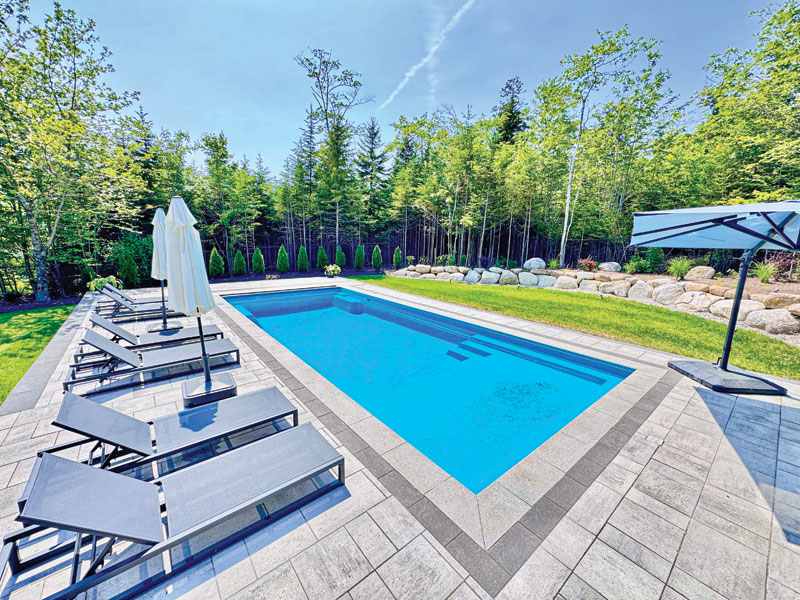
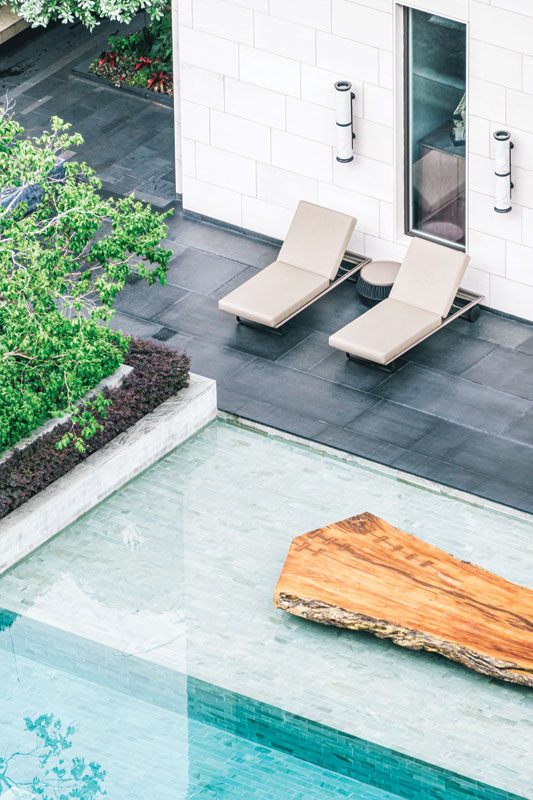
The same shift toward intention is showing up in the finishes homeowners are choosing. Research shows that the traditional light-blue plaster pool is giving way to deeper, moodier interiors in graphite, charcoal, deep teal, emerald, and even black. Beyond the dramatic look, darker finishes tend to reduce surface glare, hide minor imperfections, and absorb more solar heat, all of which make the pool feel more like a natural body of water than a manufactured feature. While these darker pool finishes are gaining popularity for their dramatic, natural esthetic, safety experts note that these finishes can reduce underwater visibility. Organizations like the Lifesaving Society and Red Cross emphasize that clear visibility is a critical factor in drowning prevention, as it allows for quicker recognition of a person in distress beneath the water’s surface.
Darker interiors absorb more light, reducing contrast between the pool floor and a swimmer’s body, particularly in low-light conditions or shaded environments. This can make it more difficult to detect someone underwater, especially children or individuals wearing darker swimwear.
As a result, while the design trend continues to grow, homeowners and designers must pair darker finishes with enhanced safety measures. These can include adequate underwater lighting, consistent supervision, high-contrast safety markings (such as on steps and ledges), and adherence to best practices outlined by water safety authorities.
Pebble and glass-bead finishes are also gaining popularity for the texture and slip resistance they add. Around the pool, large-format porcelain tile and textured natural stones such as travertine, sandstone, and limestone are becoming the go-to for decking. This is because they stay cooler underfoot, resist slipping, and age gracefully in Canadian freeze-thaw conditions.
This direction is echoing across the wider design world. Pantone’s 2026 Colour of the Year is Cloud Dancer, a warm-leaning white described as a “calming influence in a frenetic society,” and Benjamin Moore’s is Silhouette, a soft burnt umber from a palette the brand is calling “refined elegance.” Across the board, the major colour forecasts for 2026 are leaning toward calm, grounded, and nature-adjacent, the same terms homeowners use to describe what they want from their backyards.
Beyond the pool: Lighting, zones, and maintenance
The role of the backyard is also expanding well beyond the pool itself. Rather than serving as a single focal point, the space is now designed as a layered environment made up of distinct zones, each supporting a different function. These can range from outdoor kitchens and dining areas to lounge spaces, fire feature seating, and quieter corners dedicated to relaxation or wellness. The result is a backyard that flows naturally from morning routines through to evening use, making it cohesive while still serving multiple purposes.
Lighting is becoming one of the quiet workhorses behind this layered approach. Outdoor lighting is moving decisively toward warm-temperature LEDs in the 2700 to 3000K range, away from the cooler, harsher light that once dominated landscape design. Fixtures themselves are disappearing into the architecture.
LED strips are integrated into steps, under coping, beneath bench seating, and along retaining walls, so the glow is seen rather than the hardware. The most well-designed backyards now use layered lighting. Path lights for movement, accent lights for trees or sculptural elements, wash lights for broader surfaces, and task lighting for outdoor kitchens and dining areas are all tied together through a single smart control system. There is also a noticeable shift toward DarkSky-friendly design, with shielded, downward-facing fixtures that preserve the natural night while still creating an inviting atmosphere. The result is a space that feels as important after sunset as it does during the day.
This mirrors what has been happening in interior design for years, where open layouts are balanced with clearly defined areas for specific activities. Canadian landscape design principles also support the direction. The Canadian Society of Landscape Architects (CSLA) emphasizes the role of design in creating outdoor environments that are both sustainable and functional, reinforcing the importance of spaces that go beyond esthetics to support real, everyday use.
That same mindset is showing up clearly at the homeowner level, not just through designers and architects.
As Kondi explains, “With the general shift from pools and spas being luxury and entertainment items, to being products that promote physical and mental health and wellness, clients are wanting to use their outdoor spaces as often as they can and for as long as they can.”
This is more evident as homeowners think beyond the pool and consider how the entire space supports their daily routines. When clients are walked through how they might use the space throughout the day for morning coffee, family time, or evening relaxation, the design naturally evolves to accommodate those moments. What begins as a pool project quickly expands into something more intentional.
Wellness is driving design
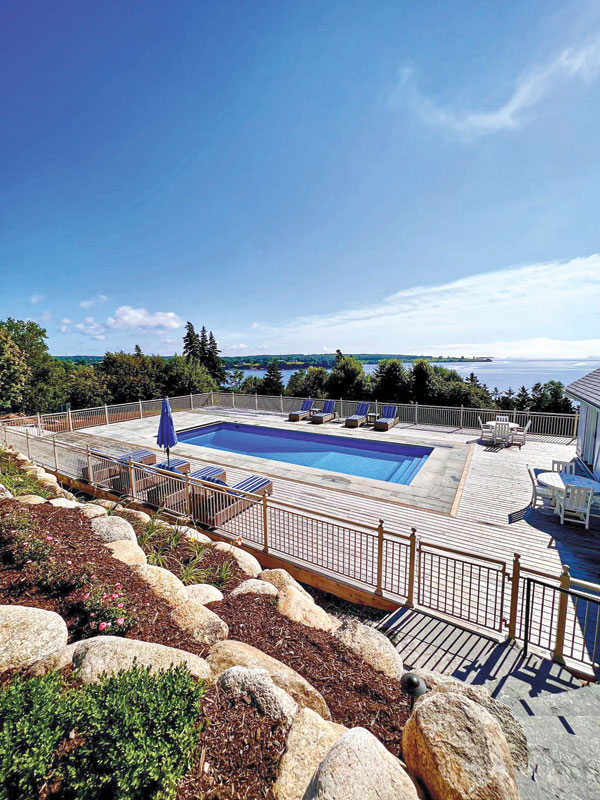
Another major influence shaping outdoor design is the ever-growing emphasis on wellness. Pools and spas have long been associated with relaxation, but they are increasingly being positioned as tools for physical health and mental well-being. Research from the Global Wellness Institute (GWI) highlights just how quickly this sector is growing: wellness real estate reached $548 billion globally in 2024, making it one of the fastest-growing segments of the wellness economy. That direction is becoming more visible in the pool and spa industry.
Features that support movement, recovery, and everyday use are becoming more central to the design conversation. Swim spas, swim jets, and hydrotherapy features are more common, particularly among homeowners who prioritize fitness as part of their daily routine.
“The biggest design trend we’ve seen over the past year is the growing focus on the fitness and exercise benefits of pools. We’ve installed more fibreglass lap pools than ever before, as more clients are specifically requesting pools designed for swimming laps or equipped with swim jet systems to enhance their workout experience. This shift represents a significant change from what we’ve seen in the past, highlighting how backyards are evolving to meet more health-focused needs,” Russell says.
Design is also trending toward more natural, retreat-like environments that promote calm, comfort, and restoration. Priest is seeing this reflected in how clients approach the overall feel of their backyard. “I’ve noticed a move toward natural, retreat-style backyards. Think cottage-inspired esthetics with lush landscaping and spaces designed to help people relax and recharge,” he says.
This aligns closely with the principles of biophilic design, an approach rooted in the idea that humans have an inherent connection to nature. The concept builds on the “biophilia hypothesis” proposed by Edward O. Wilson, a Harvard biologist and leading authority on biodiversity, who argued that humans have an innate affinity for the natural world. It means that affinity for nature is not a preference but a biological need. In practice, this means incorporating natural materials, organic shapes, water elements, and layered landscaping to create environments that feel immersive rather than constructed. It is not simply about adding greenery; it is about designing spaces that reduce stress, support well-being, and feel intuitively comfortable to spend time in.
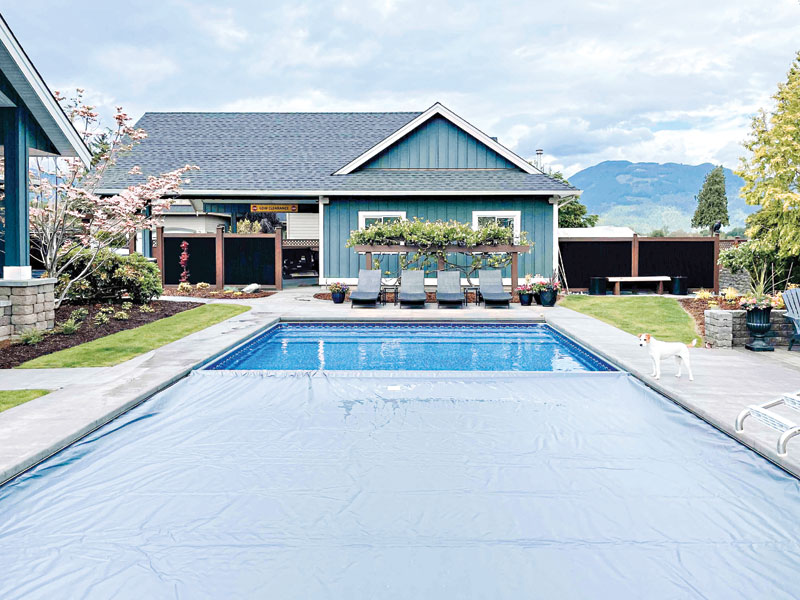
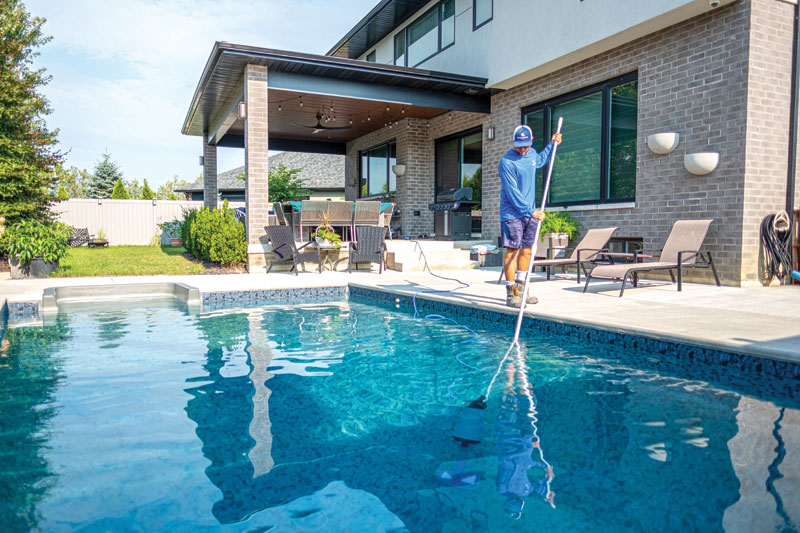
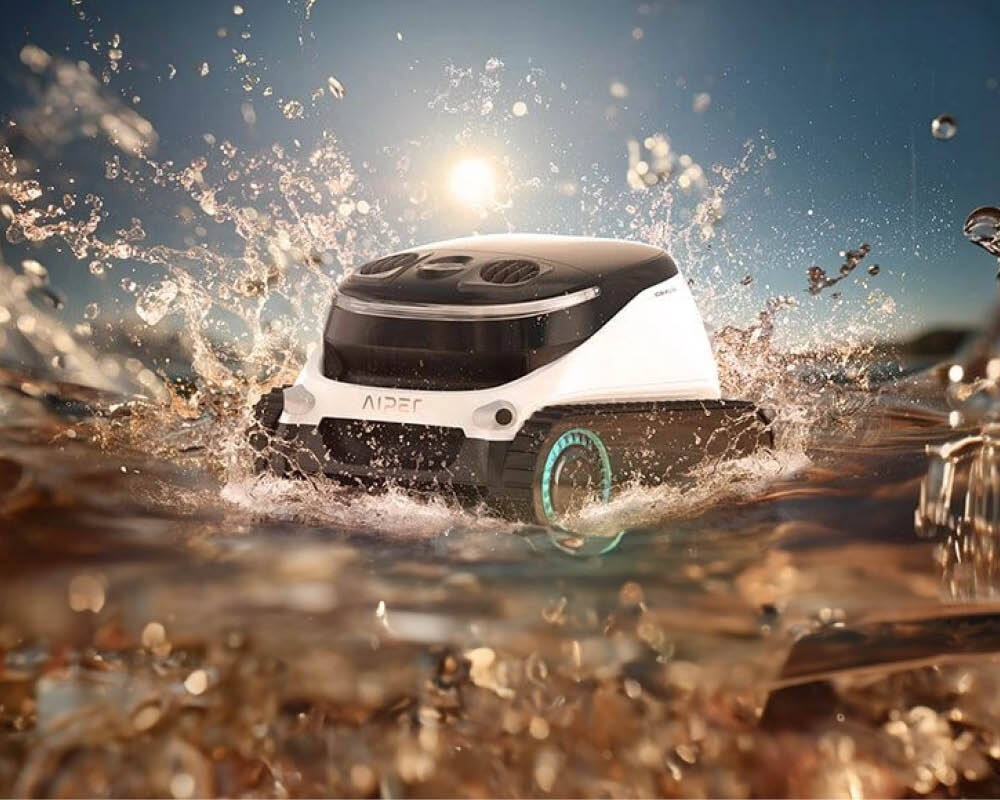
Alongside these lifestyle considerations, a practical expectation is shaping decisions across every market segment. Homeowners want spaces that are easy to maintain. Busy schedules, time constraints, and a desire for simplicity are driving a shift toward materials and systems that reduce ongoing maintenance. In response, the industry is seeing increased adoption of automatic covers, advanced filtration systems, durable hardscaping materials such as stone, tile, and composite surfaces, and the use of wildflowers in place of traditionally higher-maintenance plantings. Landscaping is evolving alongside simplified planting schemes requiring minimal care. Artificial intelligence (AI)-powered robotic pool cleaners now use intelligent mapping to optimize cleaning paths, while automated chemical monitoring systems balance water chemistry in real time with minimal intervention. Smart irrigation, robotic lawn care, and integrated control systems extend this low-maintenance approach beyond the pool itself, enabling automation to rapidly transform the entire backyard environment.
The result is a clear shift in expectation
Homeowners are no longer asking how to maintain their space—they are asking how little they need to think about it.
Kondi emphasizes that ease of maintenance is becoming a key factor in how homeowners approach the design process. Rather than focusing solely on how a space looks, clients are thinking more holistically about how it will function over time and what it will require from them day to day.
“They are designing them, not just intentionally for lifestyle and esthetics, but also for ease of maintenance. They want to be able to enjoy and use without constant upkeep,” Kondi says.
Seasonality is also being reconsidered, particularly in Canadian markets where outdoor use traditionally has a shorter window. Design strategies are now being developed to support three-season or extended use, with built-in heating systems, covered structures, wind protection, and lighting.
“People are truly planning on their outdoor spaces to be at least three-season spaces, and plan to accommodate this,” Kondi explains. He notes that homeowners want to use their backyards “if not year-round, then at least well into the shoulder seasons. We are seeing clients adding snow melt zones around pools and spas for easier and more comfortable winter use.”
Homeowners frequently begin the process with assumptions shaped by past experiences or inspiration gathered online. As the design process unfolds, those ideas are refined through practical considerations and a deeper understanding of how the space will be used.
Today’s homeowner is also arriving more informed than ever, shaped by constant exposure to design platforms, social media, and emerging AI tools. They often come in with highly curated ideas. Builders who can take that inspiration and translate it into something that works within real-world constraints will have a clear advantage.
With such easy (and often overwhelming) access to images and ideas online (e.g. Pinterest, TikTok, Instagram), clients often come in with ideas that they have seen on these platforms. “Often, however, the images are from climates very different from ours, making their top choices either not recommended or sometimes even impossible,” says Kondi. “For example, covers aren’t typically ‘pretty,’ and are seldom shown in beautiful pool photos, yet are important (if not necessary) for our clients based on climate, safety, or bylaws. Clients will often choose a pool shape that cannot easily accommodate an auto-cover, and once they are informed of this, they choose a rectangular pool.”
Priest describes a comparable evolution in how projects take shape. “Most clients come in wanting something familiar. A simple pool with a standard concrete patio, similar to what they’ve had before,” he says. “But once they see what’s possible, their vision quickly evolves. The result almost always exceeds their original expectations.”
This highlights the growing importance of guidance and expertise within the industry. The role of the builder or designer now extends beyond execution to helping homeowners shape a vision that is both achievable and aligned with how they live. Leaders who build feedback loops within their organizations, gathering insight from service teams and past customers, can refine future designs and identify opportunities for both new projects and meaningful upgrades for existing clientele.
One of the most significant opportunities for professionals lies in translating inspiration into reality. Tools such as 3D landscape design software are increasingly being used to bridge gaps, allowing professionals to quickly visualize concepts, test layouts, and communicate ideas in a way clients can clearly understand. At the same time, expanding connections with landscapers, manufacturers, suppliers, and builders is becoming a key competitive advantage. Those who build strong industry relationships will be better positioned to deliver fully integrated projects, offering clients a seamless experience from concept through completion. In a market where expectations continue to rise, collaboration is no longer optional; it is what sets leading professionals apart.
Across the industry, a clear pattern is emerging as homeowner expectations continue to evolve. Russell captures this shift succinctly: “The backyard is becoming a complete lifestyle space, not just a standalone feature.”
In that sense, designing for real life is no longer a niche concept. It is becoming the standard.
Author

Crystal Lengua is the vice president of Canadian operations at Cover Valet, bringing 25 years of experience in the pool and spa industry. Widely recognized as a “Power Woman” in her field, she is known for her leadership and many career achievements. Outside the office, Lengua shares her expertise through seminars, trade show presentations, and contributions to publications such as Pool & Spa Marketing. A York University graduate and advocate for female empowerment, her education includes marketing management, public relations, and corporate communications, along with professional experience in sales, social media marketing, and event management. She also holds a certification in mindfulness meditation from the University of Toronto.
Sign up for our newsletter
Get all the latest news and features from Pool & Spa Marketing. Submit your email below to get our twice-monthly newsletter.
Products

Read the Latest Issue