
Taking stock: Smarter inventory management for pool & spa pros

In today’s unpredictable market, maintaining strict inventory control is vital for pool and spa businesses. Accurate, up-to-date tracking helps prevent overstocking or understocking, supports cash flow, and boosts operational efficiency during peak seasons. As demand fluctuates and supply chains remain variable, real-time inventory access allows for quicker decisions on purchasing, promotions, and customer service.
Consider a common summer situation: demand for chlorine, pool shock, algaecides, and pH balancers increases sharply. If a retailer relies on weekly chlorine tablet shipments and a delay of five to seven days occurs—due to manufacturing problems, weather, labour shortages, or fuel disruptions—the result is stockouts, unhappy customers, and lost sales. These problems are especially damaging when customers need immediate water treatment to keep pools safe and operational.
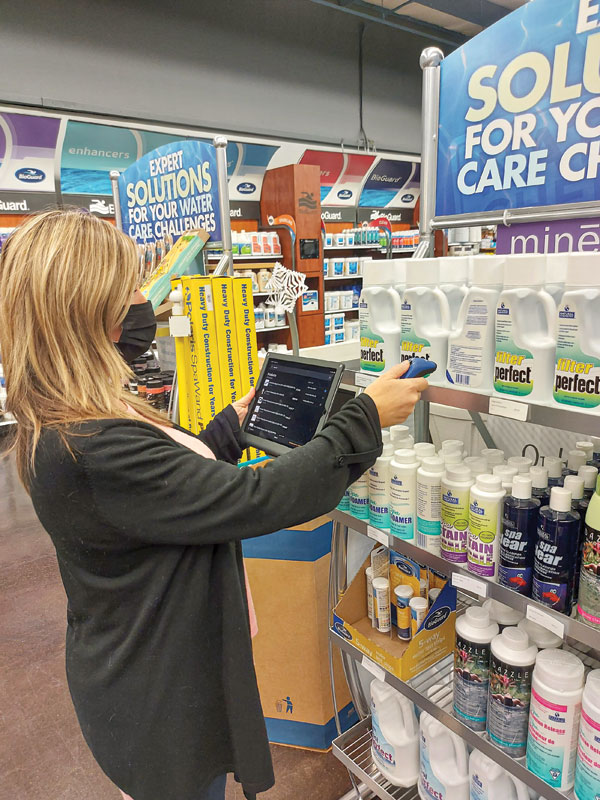
Store-to-store transfers
If one location is low on chlorine but others still have stock, real-time data allows for quick decisions to transfer goods between stores before a shipment is delayed.
Proactive reordering
With real-time inventory visibility, the retailer can detect unusual stock depletion more rapidly.

Must-haves for an effective inventory management system
A reliable system should support cycle counts, logistical planning, and multi-location tracking. Look for the following features:
System integration
Software should connect smoothly with key business platforms such as accounting systems, point-of-sale tools, and order management software. Integration reduces errors and saves time.
A technician uses a part on a job, but it does not get deducted from store inventory because it is written on paper or not in a connected system, causing inaccuracies.
Overcome this by using integrated management software that connects to point-of-sale (POS) and accounting platforms. If the tech deducts inventory in real time using a mobile app, then the store inventory is properly accounted for.
Industry vendor connectivity
Access to vendor catalogues, inventory availability, and order status in real time before placing an order helps avoid delays and stockouts.
Real-time vendor integration allows the pool retailer to:
- Instantly verify supplier inventory
- Place and track the order without calling or emailing
Search and reporting tools
The ability to search inventory by department, vendor, product type, or description—and generate customized reports—supports smarter forecasting and sales planning.
- Fast-moving inventory report
○ Purpose: Identifies top-selling items (e.g. chlorine tablets, shock, test kits, algaecide) by SKU, vendor, or category.
○ Value: Helps ensure popular items are reordered before they run out, reducing stockouts and rush orders.
- Low stock/reorder point report
○ Purpose: Flags products that have reached or fallen below their reorder threshold.
○ Value: Prevents loss of sales and customer dissatisfaction due to out-of-stock items.
- High margin item sales report
○ Purpose: Highlights best-performing products in terms of profit, not just volume.
○ Value: Focuses marketing or upselling efforts on high-margin SKUs (e.g. robotic cleaners, UV systems).
Limitations of spreadsheet-based tracking
Table 1
| Feature / Factor | Real-time Inventory Tracking | Tracking Using Manual Spreadsheets |
| Accuracy | Automatically updates inventory when a sale, return, or restock happens | Manual data entry presents a high chance of human error |
| Time efficiency | Saves hours with automation | Time-consuming, especially with multiple SKUs |
| Stock visibility | Instant view of stock levels across all locations | Limited visibility, especially for multi-location businesses |
| Customer satisfaction | Prevents overselling, enables quick fulfillment | Risk of promising out-of-stock items |
| Integrations | Connects with point-of-sale (POS), e-commerce, and accounting tools | No direct integrations—manual updates are required |
| Alerts and automation | Low stock alerts, automatic reordering | No built-in alert system |
| Scalability | Easily scales with business growth | Becomes unmanageable as inventory grows |
| Audit trail and reporting |
Tracks changes with time stamps and user logs | Limited history and traceability |
| Mobile access/cloud sync | Accessible anywhere | Usually stored locally, making it harder to collaborate |
Spreadsheets remain common in the industry but lack the automation and responsiveness required to manage seasonal, complex inventory. Manual data entry increases the chance of errors and hinders real-time visibility, especially during busy months. Dedicated inventory software streamlines operations and supports the following: (See Table 1)
Ensure stock availability
Real-time tracking helps ensure the availability of high-demand items like chemicals, pumps, and accessories. Avoiding stockouts during peak seasons prevents lost sales and customer frustration.

Prevent overstocking and understocking
Live inventory data helps businesses find the right balance. Overstocking ties up capital and storage space, while understocking can lead to missed opportunities.
Improve cash flow
Excess inventory decreases liquidity, while shortages cause revenue loss. Real-time tracking helps maintain optimal stock levels that boost cash flow.
Reduce shrinkage

Accurate tracking helps identify discrepancies between recorded and actual stock, flagging issues such as damage, loss, or theft. This improves inventory accuracy and supports operational transparency across teams.
For example, consider a scenario where a pool company’s accounting team notices that chlorine tablet sales have remained flat over a six-week period, yet inventory levels are decreasing faster than expected. A routine usage versus sales report—comparing product outflow from the warehouse and service vans against POS transactions—reveals a shortfall of 15 buckets
(11 kg [25 lb] each), representing about $1,100 worth of unaccounted product at wholesale cost. In this situation, each bucket removed from the warehouse is matched to either a retail sale or a documented service use. Several buckets have been signed out by service technicians but never recorded on job tickets. In this scenario, two technicians are taking extra product, and one is reselling chlorine to private clients. The business catches a shrinkage issue hidden within the service fleet—a common blind spot. By integrating inventory tracking with service management tools and reinforcing accountability, the loss is stopped and operational discipline is strengthened.
Support sales and promotions
Inventory data helps schedule timely promotions by spotting overstocked items and ensuring high-demand products are not discounted unnecessarily.
- Inventory report shows excess of a seasonal or slow-moving product (e.g. pool floaties).
- Promotion type:
○ “Buy One, Get One 50% Off”
○ “End-of-Season Clearance – 30% Off While Supplies Last”
- Result: Clears shelf space, recovers capital, and avoids dead stock.
Run a “Splash Sale” on slow-moving pool toys that were taking up valuable display space. By bundling them with best-selling chlorine, they cleared out the inventory within a week.
Why this matters for pool and spa retailers
Pool and spa businesses manage large SKU volumes across retail, construction, and service sectors. Real-time tracking improves on this complexity better than static spreadsheets. Seasonal unpredictability creates additional challenges—demand for products like algaecides or pumps can suddenly increase with weather changes. Manual systems are not designed to handle these shifts quickly enough, raising the risk.
In disaster scenarios like hurricanes or floods, speed and visibility are everything. Real-time inventory management enabled this business to:
- Act hours—not days—faster than competitors
- Make better use of existing stock
- Avoid lost sales during critical moments
Businesses relying on spreadsheets or disconnected systems:
- Were unaware of how low their inventory levels were for key items (e.g. pumps, vacuums, shock).
- Placed orders too late—vendors were already backlogged.
- Missed the opportunity to transfer products between locations before roads were fully closed.
Special-order and custom products—such as custom liners, safety covers, or spas—require accurate tracking to prevent delays or errors. Real-time systems help ensure these orders stay on course.
Manual tracking using spreadsheets, emails, or paper tickets introduces several failure points:
- Orders with vendors may not be correctly logged in the POS or customer relationship management (CRM)
- Staff might forget to update expected delivery dates
- Customers call for updates, but accurate information cannot be provided
- Incorrect items—like wrong spa sizes or liner colours—may be ordered or delivered
- Products arrive, but customers are not notified, or worse, they sit in the warehouse for too long
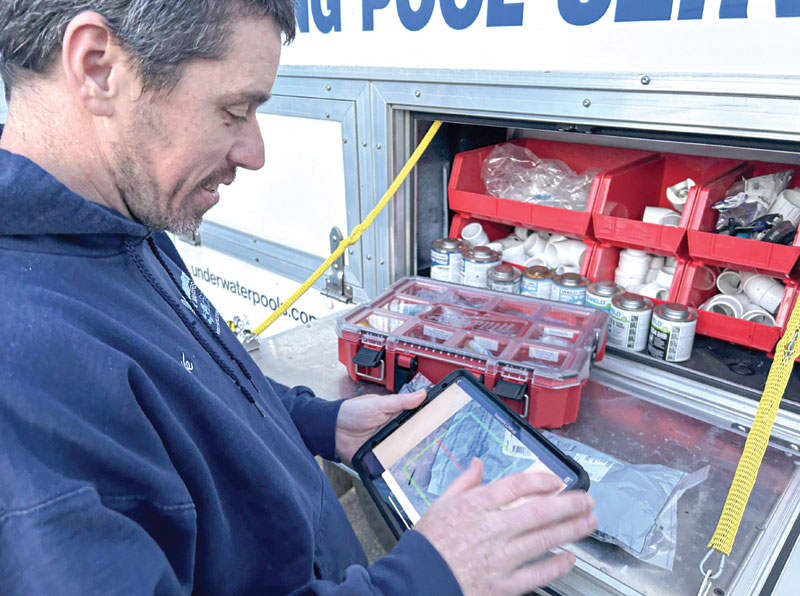
Service businesses must carefully manage parts and products used in the field. Real-time tracking technology enables stock to be monitored across multiple locations or different service vehicles—something manual systems are not designed to handle efficiently.
To effectively manage inventory across mobile service units, the following best practices can be implemented:
- Assign each vehicle its own inventory location
○ Treat every service van as a “mini-warehouse” within the inventory system
○ Track the movement of products in and out of each vehicle
○ Generate accurate usage reports by technician and location
- Use mobile-friendly inventory tools
○ Equip technicians with barcode scanners or mobile apps
○ Log materials used on-site
○ Trigger inventory deductions in real time
○ Use barcode scanning to reduce manual entry errors
- Conduct regular van cycle counts
○ Schedule weekly or biweekly physical inventory checks of each service vehicle
○ Compare expected versus actual stock to identify discrepancies, loss, or unrecorded use
- Track inventory transfers
○ Require technicians or warehouse managers to document all product transfers:
- Warehouse to van
- Van to van
- Van to customer job
- Ensure transfer logs are timestamped and linked to specific users to maintain accountability
Beware of apps that fail to track inventory
Some apps provide useful billing, scheduling, or route management tools but lack inventory tracking features. Others may offer “free” inventory tools with limited functionality unless upgraded. Many do not integrate with industry vendors, which complicates order management. Businesses should select a system that offers robust tracking capabilities, integrates with industry vendors, and supports multi-location operations to address their specific inventory management needs.
Commonly used tools that fall short for inventory tracking
Table 2
| Tool Type | Why It Is Used | Why It Is a Problem |
| Spreadsheet Software (e.g. Excel, Google Sheets) |
Easy, free, familiar | ● No real-time syncing across teams or locations
● No alerts, audit trails, or automatic updates ● High risk of human error or duplication ● Not scalable for field or multi-site operations |
| Accounting software alone (e.g. QuickBooks without inventory modules) | Already used for finances and invoicing |
● Does not track physical movement of stock in real time
● Updates only after sales, not during transfers ● Lacks mobile access for field technicians |
| Messaging apps or email | Quick way to ask, “Do we have this part?” |
● No searchable record or audit trail
● Easy to overlook or misinterpret ● Not linked to actual inventory counts or reorders |
Some pool and spa businesses continue to rely on general-purpose tools for inventory tracking. While familiar and convenient, these tools often lack the functionality needed for real-time, multi-location inventory control. (See Table 2)
Real-world example
Consider this common scenario: A customer calls to check availability on a specific pool pump. With real-time inventory, staff can check instantly and reserve the item. The data might be outdated with a spreadsheet, risking a lost sale or a poor service experience.
While a spreadsheet may be sufficient for small operations in the short term, it quickly becomes a limitation as the business expands. Real-time systems provide a clear competitive advantage in a seasonal industry with complex inventory demands and mobile service fleets.
Inventory tracking enhances customer satisfaction
Knowing exactly what is in stock helps staff provide quick, accurate information. Customers value prompt responses, timely updates, and informed alternatives. This enhances the shopping experience and fosters trust.
As seasonal demand changes swiftly, a real-time system reduces the burden on staff and improves operations. Investing in an automated inventory system is a practical step toward better service and increased profitability for any business aiming to stay responsive and efficient.
Author

Rachael Pritz has been active in the pool industry for more than 20 years, which has provided her with all-encompassing expertise in the trade. She worked at a local pool store while pursuing a master’s degree at the University of Pittsburgh, Pa. With her technical skills and industry knowledge, she joined the launch of RB Retail & Service Solutions in Pittsburgh in 2003. She can be reached at rachael@rbcontrolsystems.com.
Sign up for our newsletter
Get all the latest news and features from Pool & Spa Marketing. Submit your email below to get our twice-monthly newsletter.
Products

Read the Latest Issue