
The cost of staying manual: Outdated systems quietly cut into profits
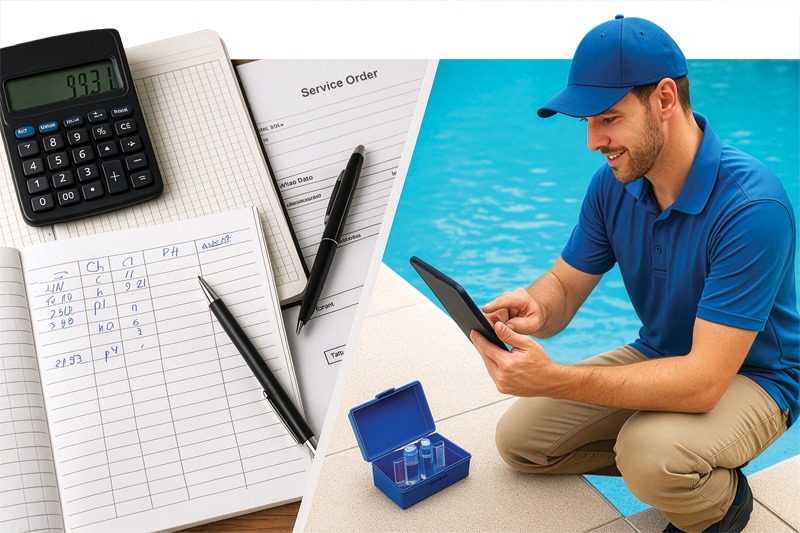
After attending several pool and spa industry trade shows and events, it is surprising to see how many business owners still rely on pen-and-paper methods or basic spreadsheets to manage scheduling, inventory, and customer service. The hesitation often comes from common misconceptions that business software is too expensive, too complex, or unnecessary. However, in today’s competitive market, those assumptions can quietly erode profits and hinder growth. Modern business management tools designed for pool and spa professionals are now easier to use and more affordable than ever—and choosing not to adopt them can ultimately be the costliest decision of all.
In one industry trends study, it was noted that in 2025, only eight per cent of businesses’ budgets (on average) are being allocated for “software,” down from approximately 12 per cent. This implies that although digitization is on the radar, the actual investment level remains modest.¹
Many pool and spa businesses are beginning to adopt digital tools, including mobile apps, cloud scheduling, and customer management platforms; however, a sizable portion still relies on manual processes. The budget data (eight per cent) underscores that, for many, digital adoption remains in its early stages rather than representing full-scale integration.
Myth 1: “It is too expensive”
At first glance, investing in business software may seem like a considerable expense. However, when you consider the ongoing costs associated with manual processes, the situation looks quite different. Businesses often waste countless hours sorting through paperwork, resolving scheduling conflicts, or searching for misplaced invoices. Each of these inefficiencies results in tangible financial losses for the company.
When pool and spa businesses move from manual processes to digital systems, the strongest return on investment (ROI) typically comes from gains in labour efficiency, billing accuracy, technician productivity, inventory control, and payment collection. By eliminating double entry, automating scheduling and invoicing, tracking inventory in real-time, and using tools such as online bill payments and digital work orders, many businesses reduce their administrative workload, increase service revenue through fewer missed charges, and decrease inventory shrinkage. Taken together, these improvements often generate a rapid and measurable return, with the software investment commonly recovered within the first year.
Modern business management software often pays for itself quickly through labour savings and improved accuracy. Automated scheduling reduces missed appointments, digital invoicing accelerates payment collection, and integrated inventory tracking minimizes unnecessary purchases. Rather than functioning as an added expense, the right software becomes a profit-generating tool.

For example, a 10-employee company investing approximately $5,000 per year in software tools could save eight hours of administrative time each week (about $9,000 per year in labour), recover a single missed chemical or parts charge per day (about $12,000 per year), and reduce inventory shrinkage by 15 per cent (about $5,000 per year). In a scenario like this, the business typically recovers its entire investment within two to three months, with the remaining savings contributing directly to profit.
Myth 2: “It is too complicated”
Many business owners worry that learning new technology will take too much time or that their team will struggle to adapt to it. That concern may have been valid a decade ago, but today’s pool and spa management software is built with simplicity in mind. User-friendly dashboards, mobile applications for retail staff and in-field technicians, and cloud-based, integrated systems allow businesses to manage operations from virtually anywhere with minimal training.

Modern pool and spa business systems are far easier to use because they are built around automation, intuitive workflows, and mobile accessibility. Automated scheduling, billing, and inventory updates eliminate repetitive tasks and minimize errors. Guided interfaces guide staff through processes step-by-step, such as creating a work order, checking out a customer, or completing a service stop. Mobile applications enable technicians to update jobs, capture photos, record chemical readings, and collect payments directly from the field, thereby eliminating paperwork and reducing after-hours data entry. Additionally, smart prompts, templates, and built-in best-practice recommendations help new employees quickly ramp up without extensive training. Together, these features reduce complexity, improve accuracy, and make digital systems more approachable for teams at any skill level.
The best software providers also offer dedicated onboarding and ongoing support, guiding teams through setup and providing assistance whenever needed. Modern platforms designed specifically for pool and spa workflows, rather than generic retail systems, reflect the way these businesses actually operate, making daily tasks more intuitive. Many pool and spa professionals are surprised to discover that what once felt intimidating is ultimately far easier than keeping up with manual paperwork.
Industry-specific solutions simplify onboarding because they are built around the exact workflows pool and spa businesses use every day—service routes, water testing, retail checkout, inventory management, and repeat customer programs. Rather than forcing staff to adapt to generic software, these systems mirror real-world processes, which shortens the learning curve considerably and helps teams become productive more quickly.
Myth 3: “We do not need it”
Some business owners believe their current processes “work fine,” particularly if they have been operating in the same way for many years. However, manual systems cannot keep pace with the rising expectations of customers. Clients increasingly expect faster responses, digital payment options, and real-time service updates. Without software to streamline communication, scheduling, and follow-up, it becomes easy to fall behind competitors who provide these modern conveniences.
Customer expectations in the pool and spa industry have evolved rapidly, and many digital conveniences are now considered standard. Homeowners increasingly expect real-time communication, including text alerts when a technician is en route, digital service summaries with photos, and instant access to billing information or water-test results. Online scheduling, automated reminders, and simple digital payment options, such as text-to-pay or online bill pay, have become baseline expectations rather than premium features.

Relying on memory or handwritten notes also creates opportunities for costly errors, including missed appointments, incorrect billing, or overlooked follow-ups. Over time, these small mistakes can lead to lost revenue and diminished customer trust.
For example, a mid-sized service company recently discovered that one technician had been recording chemical readings and parts used on paperwork orders. Still, the information was often smudged or incomplete by the time it reached the office. Over the course of a single month, the team identified more than a dozen unbilled items, primarily small parts and added chemicals, that should have amounted to nearly $1,800 in revenue. A few customers also questioned their invoices because the handwritten notes were difficult to read, resulting in time-consuming follow-up calls and even a couple of negative reviews.
After transitioning to a digital system with required fields, photo documentation, and automatic invoicing, missed charges were eliminated, and customer confidence improved. The example underscores a larger point: manual errors not only cost money but can also gradually erode credibility.
The real cost of clinging to the old way
Manual management systems may feel familiar, but they carry significant hidden costs, wasted time, miscommunication, and missed opportunities. The pool and spa businesses that succeed today are those embracing technology to streamline operations, enhance service, and strengthen profitability.
When businesses modernize their operations, four core areas typically see the most immediate improvement: scheduling, invoicing, customer communication, and inventory management. Digital scheduling eliminates handwritten calendars and fragmented spreadsheets, enabling staff to assign routes, adjust workloads, and respond to last-minute changes in real time. Invoicing becomes far more accurate because service details, parts used, and photos flow directly into billing, reducing missed charges and accelerating payment collection. Customer communication also improves through automated reminders, on-the-way text alerts, digital service reports, and convenient payment links, all of which build trust and reduce inbound calls. Inventory management gains accuracy through the use of barcoding, real-time stock tracking, and automated reordering, which helps prevent stockouts, reduce shrinkage, and avoid end-of-season surprises. Together, these improvements streamline daily operations, reduce labour inefficiencies, and create a more seamless experience for both staff and customers.
The opportunity cost of maintaining manual or semi-manual systems is especially significant in a seasonal industry where roughly 80 per cent of annual revenue is generated in less than six months. Time spent on manual inventory tracking represents lost selling time. Instead of spending 30 minutes of every hour on administrative tasks, employees could use that time to assist customers, increase sales, and strengthen loyalty. During peak season, labour hours are too valuable to be wasted on outdated processes. Investing in digital tools enables staff to focus on revenue-generating activities rather than routine tasks that slow down the business.
For example, imagine a company where each technician completes 10 service stops per day during the peak summer season. If manual processes add 30 minutes to each stop and a digital system cuts that time by 15 minutes, the result is five additional stops per technician per day. At an average net profit of $80 per stop, those five additional visits generate approximately $400 in extra profit per technician per day. Over a 20-day peak month, that equates to roughly $8,000 per technician, achieved solely by eliminating manual inefficiencies.
Modern pool and spa software enables this level of productivity by automating core workflows. Maintenance routes can be scheduled automatically, invoices sent immediately after service, and chemical inventory tracked in real-time—all within a single, integrated system. Customers can also be updated with text alerts about upcoming appointments.

The bottom line
Industry-specific business software is no longer a luxury; it is a necessity for sustainable growth. The fear of change often costs more than the software itself. By adopting the right tools, pool and spa businesses can reduce waste, increase revenue, and deliver a more seamless experience for both staff and customers.
Digital platforms provide the foundation necessary to integrate emerging tools, such as artificial intelligence (AI)-based analytics, predictive maintenance alerts, automated water-care recommendations, and personalized customer marketing. As these innovations become standard, businesses already operating with connected, cloud-based systems will be able to add new capabilities with minimal disruption. Those still relying on spreadsheets or paper, however, will face costly and time-consuming transitions. In this way, technology does more than solve today’s inefficiencies; it prepares businesses to grow, adapt, and remain competitive as the industry shifts toward smarter, data-driven service models.
Instead of concentrating solely on the price of software, it is worth considering the value of allocating an additional 20 hours each week to employees to follow up on sales leads, complete more service calls, or assist customers during peak seasonal demand.

A single employee redirecting two hours per day from manual tasks to customer or service work can generate an additional $15,000 to $20,000 in seasonal revenue. A team of five to 10 employees can easily drive $50,000 to more than $150,000 in added revenue simply by eliminating manual inefficiencies.
Modern business software makes this possible. The technology is accessible, easy to use, and more affordable than ever. Purpose-built solutions now provide pool and spa businesses with the tools to work more efficiently, scale their operations, and deliver a higher level of service. The real question becomes: can a business afford not to modernize?
For companies seeking to strengthen their operations for 2026 and beyond, exploring an industry-specific management platform is an important first step. A software demonstration can help determine how digital tools can support long-term success and enhance the customer experience.
Across the pool and spa industry, there is a clear and accelerating shift toward adopting modern technology, a shift driven by tighter labour markets, higher customer expectations, and the need to operate more efficiently within a short seasonal window. Increasingly, businesses recognize that digital tools are not simply conveniences; they are becoming essential to building scalable and resilient operations.
From mobile service apps and automated scheduling to integrated point-of-sale systems and cloud-based updates, these technologies are reshaping how companies manage workflows, communicate with customers, and make informed decisions. As the industry continues to move in this direction, businesses that modernize now will be better positioned to adopt future innovations, deliver a more consistent customer experience, and maintain a competitive edge in the years ahead.

Notes
¹ To read more on these industry trends, visit.
Author

Rachael Pritz has been active in the pool industry for more than 20 years, which has provided her with all-encompassing expertise in the trade. She worked at a local pool store while pursuing a master’s degree at the University of Pittsburgh, Pa. With her technical skills and industry knowledge, she joined the launch of RB Retail & Service Solutions in Pittsburgh in 2003. She can be reached at rachael@rbcontrolsystems.com
Sign up for our newsletter
Get all the latest news and features from Pool & Spa Marketing. Submit your email below to get our twice-monthly newsletter.
Products



Read the Latest Issue