
Becoming AI-fluent: Four skills every backyard leisure team needs

In the April issue, the first article of this series introduced the Iron Man metaphor: AI does not replace the hero—it augments the hero. The team is Tony Stark; AI is the suit. The question is not whether to use AI; it is whether it will be used like a search engine—typing questions and scanning results like a fancier Google—or whether it will be used to fly the suit. This article is about flying the suit.
That first article also identified four skills that separate AI tourists from AI practitioners: choosing the right tools, prompt engineering, concept engineering, and context window management. This article explores each skill in greater detail and provides practical guidance for applying them effectively.
One note: everything in this article applies to any AI platform—ChatGPT, Claude, Gemini, Copilot, or the purpose-built applications to be introduced later in this series. These are universal skills, but the difference between a mediocre and an extraordinary AI user is not which tool they use, but how well they have learned to communicate with it.
Skill #1: The real cost of free
It is important to start with the decision that most dealerships get wrong, because it caps everything else.
Free AI tools are demonstrations. They are designed to show what is possible and to hook people, not to deliver business-grade capability. Using free-tier AI for professional work is like test-driving a sports car, then trying to win a race in the dealership’s courtesy shuttle.
What free AI provides
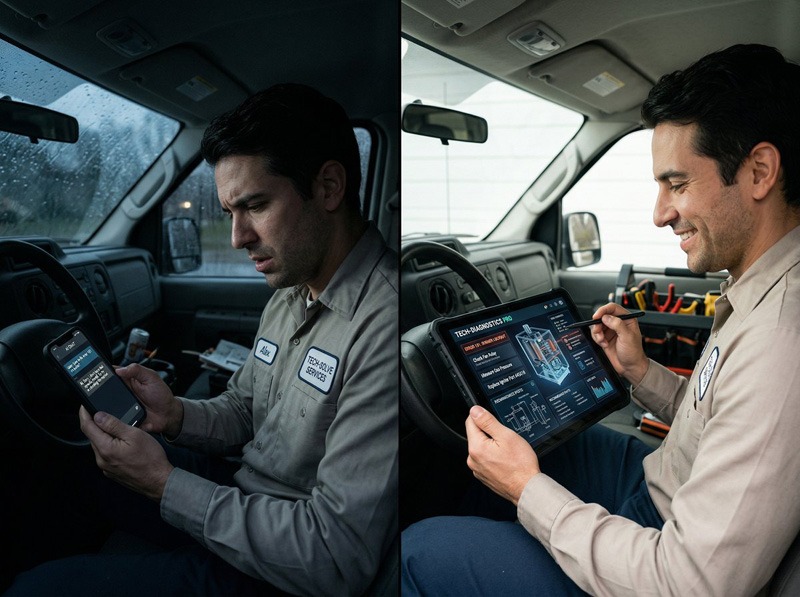
Using only free AI platforms limits access to older, slower models and imposes strict daily usage caps, which can prevent further use once those limits are reached. They offer small context windows, so the AI forgets critical details mid-conversation. They also lack privacy protections, as questions, product knowledge, and diagnostic approaches may be used to train the next model version. Lastly, there is no way to create persistent configurations, as each session starts from scratch.
Imagine JARVIS with amnesia. Every morning, Tony Stark must re-explain the suit, the mission, the physics, and who the bad guys are. That is what free-tier AI is like.
What paid AI provides
At $15 to $35 per month per user, it unlocks a fundamentally different tier:
- Current-generation models—The reasoning capability between free and paid tiers is not incremental; it is categorical. Paid models can handle multi-step diagnostic reasoning, nuanced product comparisons, and complex troubleshooting sequences that free models cannot.
- Expanded context windows—Free tiers hold roughly 10 to 15 pages of active memory; paid tiers can retain 50 to 200 pages. For a technician performing a complex equipment diagnosis with multiple variables, this is the difference between an AI that tracks the whole problem and one that forgets the filter type halfway through.
- Privacy protection—Paid tiers typically guarantee that conversations will not be used for model training. The user’s proprietary knowledge remains with them. In a competitive industry where businesses’ diagnostic expertise is their moat, this matters.
- Persistent memory and custom configurations—The ability to create AI assistants that remember product lines, regional water conditions, and service protocols, session after session.
This is where the JARVIS analogy becomes literal. It is not starting from scratch; it picks up where the conversation left off, with an AI that already knows all the business details.
The math
A team of five with paid subscriptions costs between $75 and $175 per month. That is less than the revenue from a single service call. If those five team members each save one hour per week through better diagnostics, faster customer responses, and more efficient troubleshooting—and as discussed in the first article of this series, a Harvard Business School study of 758 management consultants at Boston Consulting Group found that AI users completed tasks 25 per cent faster and produced results 40 per cent higher in quality—the return is immediate and compounding.
This is not a technology expense; it is a capability investment. The dealership that treats it as the former will always lose to the dealership that treats it as the latter.
Skill #2: The art of asking
Prompt engineering sounds like a skill for software developers. However, it is a skill for anyone who has ever managed a new employee. When assigning a task to a new hire, the quality of their output depends entirely on the instructions they receive. Vague direction produces vague work. Specific, contextual direction produces specific, useful work. AI is the same—except it processes instructions in seconds instead of hours.
Side-by-side: The Google prompt versus the JARVIS prompt
The Google approach: “Cloudy pool water after rain. What do I do?”
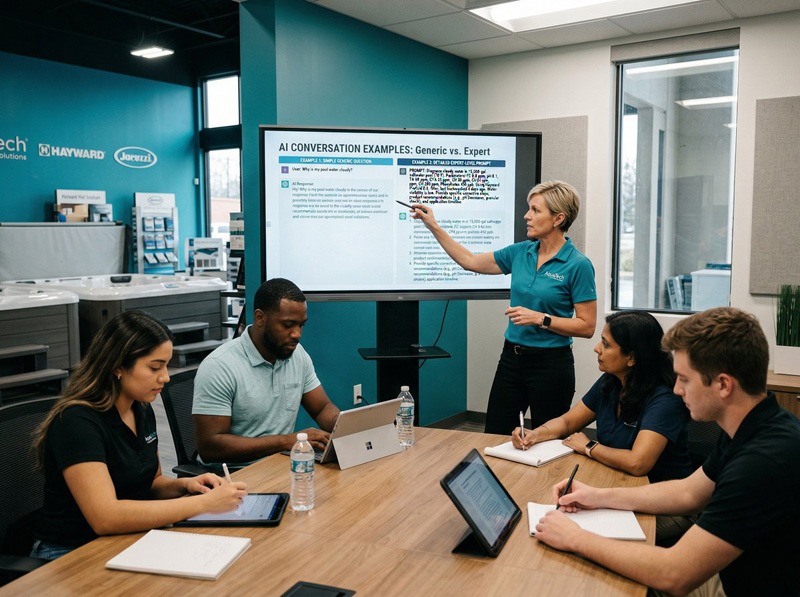
Result: A generic list. Check your filter, test your water, shock the pool, add a clarifier, and wait. This is useful in the way a first-aid pamphlet is—technically correct but practically inadequate for the specific situation.
The JARVIS approach: “You are a water chemistry expert specializing in Canadian residential pools. I’m a service technician in Calgary, Alta. My customer’s 40,000-L vinyl-lined pool has been cloudy for three days after a severe rainstorm that brought significant debris. Here are the test results: total chlorine 5 ppm, free chlorine 0.5 ppm, pH 7.8, alkalinity 110 ppm, calcium hardness 280 ppm. The last treatment was a calcium hypochlorite shock four days ago. The pool uses a diatomaceous earth (D.E.) filter that was last backwashed two days ago. The customer uses ‘XYZ’ water treatment products. What is the most likely cause, and what is the correct treatment sequence?”
Result: A specific diagnosis—combined chloramine lock from organic storm runoff overwhelming the available free chlorine—along with a step-by-step treatment plan using the customer’s actual product line, adjusted for the D.E. filter and Calgary’s water chemistry, including dosing calculations, timing intervals, and an expected resolution timeline.
Same AI and same technology. The difference is entirely the human’s skill at framing the question. Prompt engineering is the practice of being specific enough for AI to be brilliant, rather than generic enough for it to be mediocre.
Skill #3: Teaching AI to think like the business
If prompt engineering is the art of asking better questions, concept engineering is the art of building a better brain for the AI to think with.
Here is the core problem: generic AI knows a little about everything. It knows what calcium hardness is, what a D.E. filter does, and the basics of water chemistry. But it does not know the user’s business. It does not know that a specific region’s water source creates specific challenges, or that a product line includes a proprietary calcium management system. It does not know the user’s diagnostic hierarchy, the decision tree that the team’s best technician uses instinctively when confronted with a complex problem.
Concept engineering is the practice of encoding that knowledge into a structured format for AI to use. It is the difference between giving JARVIS a general physics textbook and giving it Tony Stark’s personal engineering notebooks, the ones with margin notes, failed experiments, and hard-won insights no textbook contains.
Building a concept layer
Step 1: Identify the core concepts. What key terms, relationships, and decision frameworks define expertise in the business? For a backyard leisure dealer, this might include a specific product portfolio and the factors that differentiate each product, such as regional water chemistry profiles, diagnostic decision trees, customer segmentation (first-time pool owners versus experienced enthusiasts), and service protocols.
Step 2: Define the relationships. Expertise is not just knowing facts; it is understanding how they connect. A veteran technician does not just know that calcium hardness matters; they know that in Calgary, calcium hardness, when combined with high pH and a plaster pool, creates a scaling risk that requires a different treatment approach than the same numbers in Vancouver’s soft water. Map these relationships.
Step 3: Create reusable templates. Build prompt templates that a team can use repeatedly. Examples include a “water chemistry diagnosis” template covering all relevant variables, a “customer consultation” template for retail interactions, and a “service call preparation” template for technicians. These templates translate a concept layer into a format anyone can use.
Step 4: Iterate and refine. A concept layer is not a one-off project. It is a living document that improves every time someone on the team discovers a new pattern, encounters an edge case, or identifies a gap. The dealership that treats its concept layer as a competitive asset—and invests in maintaining it—will build a competitive edge that competitors cannot replicate by simply buying the same AI subscription.

Skill #4: The mission briefing
This is a skill that separates competent AI users from exceptional ones, yet almost nobody teaches it.
Every AI operates within a context window—the total amount of information it can hold in working memory during a conversation. Think of it as the whiteboard in JARVIS’s operations room. There is plenty of space, but it is not infinite. When the whiteboard fills up, the oldest information is erased to make room for the newest.
For casual use, this rarely matters. For technical, multi-step work, the kind that makes AI valuable in a dealership, it is everything.
What happens when the window fills?
Imagine walking a technician through a complex equipment diagnosis over the phone. Twenty minutes in, the conversation refers back to what was discussed at the beginning: the model number, the installation date, and the error code. If they have been taking good notes, they have got it. If they have not been, it is just repetition.
AI works the same way, except the “notes” are the context window. When it fills up, the AI does not ask the user to repeat what they’ve already shared—it silently drops the oldest information. It forgets the model number mentioned 10 exchanges ago, neglects the filter type, or loses the vinyl liner constraint it was given. AI does not tell the user it has forgotten. It just produces answers that are subtly wrong and hard to catch.
Practical techniques
- Front-load critical information—Place the most important context at the start of the conversation. Include product names, equipment types, regional conditions, treatment history, and anything that defines the specific situation. Early information stays in the context window longer than later-added information.
- Use the “mission briefing” approach—Before diving into a complex task, provide a structured briefing, as Tony Stark does when briefing JARVIS before a mission. Explain the situation, the constraints, and what is needed. A well-structured opening saves context window space because AI does not need to infer meaning; it is explicitly stated.
- Know when to start fresh—If a conversation has run long and the AI’s answers start drifting—becoming more generic, forgetting earlier details, or contradicting itself—start a new conversation with a fresh briefing. A clean context window with a strong opening will produce better results than a cluttered one.
- Provide explicit reminders—Periodically restate the key parameters during a long diagnostic conversation. It takes a few seconds and prevents costly drift.
- Separate complex tasks into focused sessions—Instead of one long conversation covering diagnosis, treatment plan, customer communication, and follow-up scheduling, break it into focused sessions. Each session has a clean context window dedicated to a single task. The results are sharper because the AI’s full attention is on one problem.
Marco’s two diagnosesThe following scenario puts these four skills into practice. Marco has been a service technician for 14 months. He is capable and willing, but he lacks 20 years of pattern recognition. He is at a customer’s home, where a persistent green tint in the saltwater pool remains despite the chlorine generator showing normal output. The homeowner is frustrated. She has had two service visits already, yet the problem persists. Scenario A: The search engine approachMarco opens a free AI tool on his phone. He types: “Green pool water salt system working fine.” The AI responds with a generic list: check phosphate levels, verify salt concentration, inspect the cell for calcium buildup, and consider an algaecide treatment. The advice is “textbook correct” but practically useless. Marco has already checked phosphates and salt. The cell was cleaned last month, and he has tried algaecide twice. He tries again: “Still green after algaecide.” The AI, operating on a free tier with a small context window, has already lost the salt system detail from the first exchange. It suggests checking the pump run time and verifying chlorine levels—advice that ignores everything Marco already told it. Marco puts his phone away. He calls the office. No one there knows the answer. He tells the customer he will research it and get back to them. This means a third visit is coming, and customer confidence is declining. Scenario B: The JARVIS approachMarco opens a paid, concept-engineered AI assistant. He has been trained in the 5C approach (see page 32.) He provides a mission briefing: “You are a saltwater pool diagnostic specialist. I’m a service technician in the Greater Toronto Area. The customer’s 50,000-L (13,209 gal) fibreglass pool with a salt chlorine generator has a persistent green tint. The chlorine generator shows normal output. Here are the results from my test today: free chlorine 3.0 ppm, pH 7.6, salt 3,200 ppm, phosphates below 100 ppb, copper 0.3 ppm. I’ve treated with algaecide twice in the past two weeks with no improvement. The customer uses ‘XYZ’ water treatment products. This is my third visit. What am I missing?” The AI identifies the problem immediately: copper. At 0.3 ppm, dissolved copper in the water, likely from the heat exchanger or the original fill water, is oxidizing and causing the green tint. This is not an algae problem. The algaecide was never going to fix it. The AI recommends a metal sequestrant treatment specific to the “XYZ” water treatment product line, with a dose for 50,000 L (13,209 gal), and flags the need to investigate the copper source to prevent recurrence. Marco resolves the problem during this visit. The customer’s confidence is restored, and his diagnostic capability is permanently expanded. He will recognize copper tint on sight from now on. The AI did not replace Marco’s growing expertise; it accelerated it by years. |

Building the dealership’s AI playbook
Every dealership needs a playbook—a shared document that captures the concept layer, prompt templates, and operational standards the team uses with AI. Think of it as JARVIS’s startup configuration: the set of instructions that loads whenever the system activates.
This playbook should include:
- A product knowledge brief—Covering the specific product lines, key differentiators, competitive positioning, and the brand’s language. This is pasted into AI conversations to ensure every recommendation aligns with the product strategy.
- Regional water profiles—The specific water chemistry characteristics of the user’s service area, including source water hardness, typical pH ranges, seasonal variations, and common issues. This context transforms generic advice into locally accurate guidance.
- Prompt templates for common scenarios—Pre-built prompts for water chemistry diagnosis, equipment troubleshooting, customer consultations, seasonal opening and closing protocols, and sales interactions. Not every prompt needs to be built from scratch; they use the template and fill in the specifics.
- Guardrails and brand standards—What AI should and should not recommend. Product lines to prioritize, competitors’ products to avoid recommending, safety constraints, and liability boundaries. The playbook ensures consistency across the entire team.
- An update protocol—A simple process for adding new concepts, refining templates, and capturing edge cases. When a team member discovers a new pattern or encounters a situation the playbook does not cover, there is a clear path to incorporate that learning. The playbook compounds, and that is the economic moat.
Mastering the 5C Approach
|
What comes next
The user now has the four skills needed to thrive with AI. They understand the difference between using AI as a search engine and using it as Iron Man uses JARVIS. They can choose the right tools, craft prompts that produce expert-level output, engineer concepts that make AI think within their domain, and manage context windows so AI does not lose the thread.
The question is: where within one’s dealership do these skills create the most value?
The third article in this series, “The AHI Dealership in Action,” will walk through seven case studies from the retail floor to the service van to the customer’s backyard—demonstrating how AI augmentation turns potential failures into wins. It follows three team members through a single day at a dealership.
Finally, the last article, “Sage, Rocky, and the Knowledge Harvest,” introduces two purpose-built applications that embed everything from this article into platforms designed for backyard leisure—so teams do not need to build JARVIS from scratch. Someone already has.
The skills in this article form the foundation. What comes next is the architecture that operationalizes those skills at scale.
Author

Dennis Gray is president of Backyard Brands Inc., supporting independent Canadian pool and spa dealers across a national network. He has more than 40 years of experience developing and marketing advanced water-care technologies. He is the architect of the Augmented Human Intelligence (AHI) platform, currently deployed across more than 260 dealerships.
Sign up for our newsletter
Get all the latest news and features from Pool & Spa Marketing. Submit your email below to get our twice-monthly newsletter.

Read the Latest Issue